What Causes Cross-Border Shipping Delays and How Can Shippers Reduce the Risk?

A driver arrived at the U.S. border with a load of frozen meals we regularly transport, expecting a routine crossing. Instead, a new import requirement left the shipment waiting and the driver sleeping at the border.

A truck can leave the shipper on time, encounter no traffic, and still lose hours at the border because the customs broker does not have the right paperwork, information does not match between systems, an inspection has not been coordinated, or a required permit is missing.
Some border delays cannot be avoided. Customs examinations, weather, congestion, and other unexpected events will always be part of cross-border transportation. However, many delays begin long before the truck reaches the border.

Understanding the most common causes and addressing them before a shipment leaves the dock is key to significantly reducing the risk of unnecessary delays.

Incorrect or Incomplete Customs Documentation

Documentation problems are among the most preventable causes of cross-border shipping delays.

A commercial shipment may require information such as the product description, quantity, value, country of origin, and other details needed by the importer and customs broker to prepare the appropriate customs entry.

Problems can arise when documentation contains:

  • Incorrect or incomplete product descriptions
  • Incorrect quantities, weights, or values
  • Country-of-origin errors
  • Missing information
  • Incorrect tariff classifications
  • Discrepancies between the commercial invoice, bill of lading, and other documents
  • Information that does not accurately describe the freight actually on the truck

Product descriptions are particularly important. A description such as “parts,” for example, may not provide enough information to accurately identify the goods being imported.

The carrier can help ensure that documentation received for the shipment is forwarded to the appropriate customs broker, but the carrier is not a customs broker. The shipper, importer, and customs broker remain responsible for ensuring that customs documentation and entry information are accurate and appropriate for the shipment.

The earlier documentation is prepared and sent to the broker, the more opportunity there is to identify and resolve an issue before the truck reaches the border.

PARS, PAPS and Electronic Customs Information Must Match

Modern Canada-U.S. customs processing is highly electronic, but shipment identification and matching remain critical.

For freight entering Canada, the Pre-Arrival Review System (PARS) allows importers and customs brokers to submit release information to the Canada Border Services Agency before the goods arrive. CBSA continues to use PARS as part of the commercial release process.

For U.S.-bound freight, carriers, brokers, and importers similarly rely on electronic pre-arrival customs processes through U.S. Customs and Border Protection systems.

Problems can occur when:

  • An incorrect PARS or PAPS number is provided
  • A shipment number is duplicated
  • The customs broker has a different number than the carrier
  • Information in the carrier’s electronic submission does not match the broker’s entry
  • Shipment details change after customs information has already been submitted
  • Documents are provided too late for processing before the truck arrives

Something as small as an incorrect reference number can prevent customs systems from properly matching the carrier’s shipment information with the broker’s customs entry.

This is why cross-border planning should happen before the truck is sitting in a border lineup.

Customs Broker Problems Can Leave a Truck Waiting

Providing the name of a customs broker does not necessarily mean that the broker is ready to clear the shipment.

A shipment can be delayed because:

  • The wrong customs broker was identified
  • The broker never received the paperwork
  • Documentation was sent too late
  • The broker was not notified that the shipment was coming
  • The importer has not completed the necessary account setup
  • There is a payment or credit issue between the importer and broker
  • Nobody from the broker is available when a problem occurs

Broker availability can be particularly important for shipments moving at night, on weekends, or during holidays.

A border crossing may operate around the clock, but that does not mean every customs broker or other party needed to resolve a problem provides 24-hour service.

Canada’s commercial-import accounting environment has also changed significantly with the introduction of the CBSA Assessment and Revenue Management system (CARM). CARM is now CBSA’s official system for accounting for commercial imports and paying applicable duties and taxes.

For shippers, the practical lesson is simple: confirm the correct customs broker early and make sure the appropriate documentation reaches them before the shipment approaches the border.

Food and Meat Shipments Require Additional Planning

Cross-border food transportation can introduce another layer of complexity because customs clearance may be only one part of the import process.

Depending on the product, additional government agencies can become involved.

In Canada, the Canadian Food Inspection Agency (CFIA) regulates the importation of many food, animal, and agricultural products. In the United States, meat, poultry, and certain egg products are regulated by the U.S. Department of Agriculture’s Food Safety and Inspection Service (USDA FSIS), while other types of food may fall under different agencies.

Meat is a good example of why advance planning matters.

For meat entering Canada, importers or their representatives may need to provide certificates and other documentation to CFIA’s National Import Service Centre. Certain shipments may also be selected for inspection and directed to an establishment licensed to handle imported meat for inspection.

For meat, poultry, and egg products entering the United States, USDA FSIS also has specific import certification and re-inspection requirements, including presentation at an official import inspection establishment where required.

These processes have to be considered before the truck simply proceeds toward the border.

Inspection capacity can also become a source of delay. During periods of heavy volume, a driver may have to wait for an inspection to be completed.

For refrigerated and frozen products, an inspection introduces another operational consideration: protecting the cold chain. Inspectors may require access to the trailer or product while the carrier is simultaneously trying to minimize door-open time and maintain the required temperature.

A delay associated with a required government inspection is not necessarily preventable. Proper planning, however, can help avoid arriving without the required documents, approvals, or arrangements already in place.

We experienced the operational impact of a regulatory change firsthand with a load of frozen meals for a key customer. The U.S. Department of Agriculture’s Animal and Plant Health Inspection Service (USDA APHIS) made a change requiring an import permit and manufacturer’s statement for food products containing egg ingredients entering the United States. Applying for the permit required a complete list of ingredients of animal origin to be provided to the U.S. importer or customs broker. Without the required information in place before the shipment reached the border, the load could not proceed, and the driver had to sleep at the border while the issue was resolved.

Alcohol, Tobacco, Firearms and Other Highly Regulated Goods

Some commodities involve regulatory requirements beyond those associated with an ordinary commercial shipment.

Examples may include:

  • Alcohol
  • Tobacco
  • Firearms and certain firearms-related products
  • Some chemicals
  • Pharmaceuticals
  • Other controlled or restricted goods

Depending on the commodity and direction of travel, the importer may require specific licences, permits, declarations, tax or excise documentation, or authorization from another government agency.

The exact rules vary considerably by product, importer, origin, and destination, so these requirements should be determined by the appropriate regulatory and customs professionals before the shipment is tendered to the carrier.

For the transportation provider, the important issue is knowing that additional requirements exist and ensuring that the transportation plan reflects any special instructions that have been provided.

Discovering at the border that a permit, authorization, or regulatory step is missing can result in a substantial delay.

Timing Can Turn a Small Problem Into a Long Delay

Timing matters in cross-border transportation.

Consider a relatively simple paperwork question. During normal business hours, the carrier may be able to contact the shipper or customs broker and resolve it quickly.

The same problem at 2:00 a.m. can be very different.

Potential timing issues include:

  • Customs brokers that do not provide 24-hour support
  • Government inspection facilities with defined operating hours
  • Weekend or holiday schedules
  • Paperwork sent shortly before the truck reaches the border
  • Last-minute changes to the shipment
  • Difficulty reaching the shipper or importer after regular business hours

This does not mean shippers should avoid after-hours crossings. It means the availability of all parties involved should be considered when planning a time-sensitive shipment.

A problem that takes ten minutes to resolve when the right person is available can become a multi-hour delay when nobody knows who to contact.

Some Border Delays Cannot Be Prevented

Even a perfectly prepared shipment can sometimes be delayed.

Customs authorities may refer a shipment for further examination. Traffic can back up at a busy crossing. Severe weather can affect border operations. Government or carrier systems can experience outages.

Other potential causes include:

  • Random or targeted customs examinations
  • Increased enforcement activity
  • Border congestion
  • Accidents or road closures
  • Severe weather
  • Government system interruptions
  • Unexpected operational restrictions

It is important to distinguish these events from avoidable delays.

A shipment delayed because customs selected it for examination is very different from one delayed because nobody sent the commercial invoice to the broker.

Shippers cannot eliminate every source of uncertainty from cross-border transportation. The goal should be to remove as many preventable causes as possible so the shipment is better positioned to deal with the things that cannot be controlled.

Communication Is Often the Difference Between a Short Delay and a Long One

Cross-border transportation involves several parties, each with a different role.

Depending on the shipment, those parties can include:

  • The shipper
  • The importer of record
  • The customs broker
  • The carrier and load coordinator
  • The driver
  • The consignee
  • Government inspection or regulatory agencies

Problems occur when one party assumes somebody else has taken care of something.

Perhaps the shipper believes the broker has the documents, while the broker has never received them. A shipment detail changes but the carrier is not advised. An issue arises at night and nobody has an after-hours contact for the importer.

An experienced carrier will generally make reasonable efforts to ensure that the shipping documents it receives are directed to the designated customs broker and that known transportation requirements are coordinated before the driver proceeds to the border.

That does not mean the carrier performs the customs broker’s job or independently verifies customs compliance.

Instead, good cross-border transportation depends on keeping the various parties connected and making sure important information gets to the right people at the right time.

How Can Shippers Reduce the Risk of Cross-Border Delays?

While there is no way to guarantee that a cross-border shipment will never encounter a delay, shippers can reduce many of the most common risks.

Before Pickup

Confirm:

  • Who is the importer of record?
  • Which customs broker will handle the shipment?
  • Does the broker have the required shipment information?
  • Will the broker be available around the expected crossing time?
  • Are any special permits, certificates, or regulatory requirements involved?
  • Does the commodity require a government inspection?
  • Has accurate commercial documentation been prepared?

For regulated products, these questions may need to be answered well before the day of pickup.

Before the Truck Reaches the Border

Make sure:

  • Required documents have been sent to the appropriate parties
  • PARS, PAPS, or other shipment identification information is correct
  • The broker and carrier are working from consistent shipment information
  • Any changes to quantities, products, or shipment details have been communicated
  • Required inspections or other regulatory steps have been addressed
  • Appropriate contacts are available if an issue arises

CBSA, for example, specifically instructs carriers using PARS that the invoice or bill of lading should be sent to the broker in advance of the goods arriving in Canada.

For Time-Sensitive, Refrigerated, or Regulated Freight

Allow additional planning for:

  • Broker operating hours
  • Government inspection requirements
  • Inspection-facility schedules
  • Temperature-control requirements
  • Holidays and weekends
  • Contingency time when an inspection or referral is possible

The more complex the shipment, the more important it is to identify potential problems before the truck begins moving.

Experience Helps Reduce Avoidable Cross-Border Problems

A transportation provider cannot guarantee customs clearance, and a carrier does not replace the expertise of a licensed customs broker.

What an experienced cross-border carrier can do is understand the transportation process surrounding the border.

That includes making reasonable efforts to ensure required shipping documents received by the carrier are forwarded appropriately, coordinating information with the parties involved, understanding the additional planning required for specialized freight, and avoiding sending a driver into an obvious problem when possible.

This becomes particularly important with time-sensitive, temperature-controlled, and highly regulated shipments where a delay can have consequences beyond simply arriving late.

At XTL, cross-border transportation is part of our everyday business. Our role is to move freight safely and efficiently while working with our customers, their designated customs brokers, and other involved parties to help keep shipments moving.

The Best Time to Prevent a Border Delay Is Before the Truck Leaves

Not every cross-border delay can be avoided.

Customs inspections will occur. Weather happens. Border traffic can be unpredictable. Government agencies have their own requirements and operating constraints.

But many frustrating delays can be traced back to something that happened, or failed to happen, before the truck ever arrived at the border.

Accurate documentation, early broker coordination, proper planning for regulated commodities, and good communication between everyone involved can substantially reduce that risk.

When it comes to cross-border transportation, the best time to solve a border problem is often before the truck leaves the shipper’s dock.

Call XTL today to help plan your next cross-border shipment.

What Causes Temperature Excursions in Transit and How Can Shippers Prevent Them

While transporting temperature-sensitive freight, a small change in conditions can become a significant quality, safety or compliance concern. A temperature excursion occurs when a shipment moves outside its specified temperature range. That can mean becoming too warm or too cold depending on the specifications for the shipment. The risk is not confined to the highway while in transit, excursions can begin before a trailer leaves the dock, develop while freight is being loaded, arise during a delay or go unnoticed during unloading.

Understanding where excursions occur is the first step toward preventing them. With clear shipment requirements, careful preparation and reliable visibility throughout transit, shippers can reduce risk and respond more effectively when conditions change.

What Is a Temperature Excursion?

Every temperature-sensitive product has an acceptable range defined by the shipper, manufacturer or applicable product requirements. A temperature excursion is any period in which the product or its surrounding environment falls outside that range. For refrigerated freight, this could be an unexpected rise in temperature. For freeze-sensitive products, exposure to temperatures that are too low may be equally damaging.

An out-of-range reading does not automatically mean the entire shipment is unusable. The effect depends on factors such as the product, the temperature reached, the duration of exposure and the product’s stability data. When an excursion occurs, the cargo owner or another qualified party should assess the information and determine the appropriate disposition.

Where Do Temperature Excursions Occur?

1. Before loading

Temperature control starts before the doors close. If the product is not already within its required range, a refrigerated trailer may not be able to remove that heat quickly enough. Reefer units are primarily designed to maintain product temperature, not rapidly cool warm cargo.
Risk can also arise when the trailer has not been prepared for the shipment, the setpoint or operating mode is incorrect, or the temperature requirements communicated to the carrier do not match the product specification. A simple error at this stage can follow the load throughout the trip.

temperature controlled transport trailer

2. During loading

Loading is one of the most vulnerable points in the journey because open doors allow outside air to enter the trailer. The effect can be greater during extreme heat or cold, when loading takes longer than expected or when freight waits on an exposed dock.

How the freight is arranged matters as well. Refrigerated trailers depend on controlled airflow to distribute conditioned air around the load. Cargo stacked too close to the walls or ceiling, blocked air chutes, damaged packaging or an overloaded trailer can create warm or cold pockets even when the refrigeration unit is operating.

loading reffrigerated transport trucks

3. While the shipment is in transit

Once underway, temperature conditions can change because of an incorrect setpoint, an unsuitable operating mode, equipment performance, sensor placement or damage to doors and seals. Exterior weather also increases the work required of the unit, especially on long routes or when there is a large difference between ambient and required temperatures.

The temperature shown by a trailer sensor is also not always identical to the temperature of the product itself. Air temperature can fluctuate as the unit cycles, while the cargo may change more slowly. This is why the shipment specification and the meaning of each measurement should be understood before interpreting a reading.

4. During stops, delays and border crossings

Unplanned dwell time can extend a shipment beyond its expected operating plan. Traffic, weather, mechanical issues, border inspections and missed delivery appointments may all increase transit time. Stops can also introduce risk if trailer doors are opened or the refrigeration unit cannot operate as intended.

A delay does not necessarily cause an excursion, but it reduces the margin for error. Routes with border crossings, multiple stops or tight delivery windows benefit from advance planning and clear communication among the shipper, carrier and receiver.

5. During unloading and delivery

Temperature control does not end when the truck reaches the consignee. Waiting for a dock, opening the trailer before the receiving area is ready, slow unloading and leaving product in an uncontrolled staging area can expose freight during the final handoff.

The receiving process is also where an excursion may first be identified. Temperature records, indicators and the condition of the shipment should be reviewed according to the receiver’s procedures, and temperature-sensitive goods should be transferred promptly to the appropriate controlled environment.

delivering a temperature controlled shipment

What Commonly Causes an Excursion?

Most temperature excursions can be traced to one or more of the following factors:

Incorrect shipment instructions: An inaccurate temperature range, setpoint or operating mode can compromise the load from the outset.
Product or equipment preparation: Freight or a trailer that begins at the wrong temperature may struggle to reach or maintain the required conditions.

Restricted airflow: Poor loading patterns, blocked air paths or cargo placed beyond load limits can create uneven temperatures inside the trailer.

Door openings and handling time: Every opening exchanges conditioned air with the outside environment, particularly during prolonged loading, inspections or unloading.

Equipment, seal or sensor issues: A refrigeration-unit fault, damaged door seal or inaccurate or poorly positioned sensor can affect conditions or the readings used to evaluate them.

Packaging limitations: Packaging that is unsuitable for the product, route or expected handling time may provide insufficient protection when conditions change.

Delays and disruptions: Traffic, severe weather, breakdowns, border procedures and receiving delays can extend exposure and complicate temperature management.

Communication gaps: When requirements, changes or concerns are not shared promptly, the parties involved lose valuable response time.

How Can Shippers Reduce the Risk?

Temperature-control best practices should be matched to the product and shipment. They are most effective when responsibilities and requirements are agreed upon before pickup. Depending on the shipment, useful measures may include:

  • Provide the exact acceptable temperature range, setpoint, operating mode and any handling restrictions in writing.
  • Confirm that the product, packaging and equipment are prepared for the required conditions before loading begins.
  • Coordinate loading so the trailer doors remain open only as long as necessary.
  • Use a loading configuration that preserves airflow and respects trailer load limits.
  • Select packaging and monitoring devices appropriate to the product, route, season and expected transit time.
  • Plan for known risk points such as border crossings, multiple stops, severe weather and appointment delays.
  • Establish who should be contacted if an alert or suspected excursion occurs and who has authority to evaluate the product.
  • Ensure the receiver is ready to inspect and move the freight promptly into the correct controlled environment.

Visibility Matters in Temperature-Controlled Transportation

Even a well-planned shipment can encounter unexpected conditions. Monitoring, telematics, diagnostics and communication provide visibility into what is happening inside the trailer and can help the parties involved identify changing conditions sooner. Historical temperature records can also support investigation and informed decision-making if an excursion is suspected.
Technology does not replace proper preparation, and monitoring alone cannot guarantee that an excursion will never occur. Its value lies in creating awareness, supporting timely communication and providing a clearer record of the shipment’s conditions.

Supporting Temperature-Sensitive Freight Across Canada and the USA

XTL’s TempSolution™ services include pharmaceutical-grade refrigerated and heated transportation for temperature-sensitive freight. XTL’s temperature-controlled fleet is supported by GPS positioning, reefer telematics, real-time monitoring, diagnostics, live updates and alerts, two-way communication, online tracking and customized temperature-condition reporting.

With domestic, cross-border, dedicated and hazmat truckload capabilities, XTL helps shippers move food and beverage, pharmaceutical, dangerous goods and other temperature-sensitive products throughout Canada and the United States.

Planning a temperature-sensitive shipment? Contact XTL to discuss your product requirements, route and temperature-control needs.

Carrier Compliance in 2026: Why It Matters More Than Ever

Carrier compliance has always mattered in transportation. For shippers, the concern was never simply whether a truck showed up at the dock. The bigger question was whether the company moving the freight was properly authorized, insured, trained, monitored, and operating safely.

In 2026, that question matters more than ever.

The transportation industry is facing a more complex risk environment than it did even a few years ago. Safety expectations are higher. Customers expect greater visibility. Insurance and claims scrutiny continue to increase. Freight fraud and identity-related risks have become more sophisticated. And supply chains have less tolerance for avoidable disruption.

For shippers, carrier compliance is not just paperwork. It is part of protecting their freight, their customers, their brand reputation, and their supply chain continuity.

For XTL, compliance is also part of how we operate as a carrier. It is reflected in our commitment to safety, driver training, equipment standards, information systems, and the daily monitoring required to move freight responsibly and reliably.

Carrier Compliance Is More Than a Checkbox

When many people hear the word “compliance,” they think of documents: operating authority, insurance certificates, safety records, driver files, inspection history, permits, and required regulatory information.

Those documents matter. They help confirm that a carrier is qualified to operate and that the proper controls are in place.

But true carrier compliance goes further than collecting paperwork.

It includes how a carrier manages safety, trains drivers, monitors performance, maintains equipment, responds to exceptions, and uses information systems to keep freight moving securely and on time.

A compliant carrier is not just one that has the right documents on file. A compliant carrier is one that treats safety and accountability as part of the operating culture.

That distinction matters.

A shipper may only see the truck arrive at the dock. But behind that pickup is a chain of decisions: who is assigned to the load, whether the driver is qualified, whether the equipment is roadworthy, whether hours-of-service requirements are being managed, whether the route is appropriate, whether delivery expectations are realistic, and whether the carrier has the systems in place to identify and respond to problems before they become bigger issues.

Why Shippers Still Care About Carrier Selection

For years, shippers and logistics providers have been aware of the risk associated with poor carrier selection. If a carrier has a serious safety problem and an accident occurs, questions may be asked about whether the carrier should have been selected in the first place.

That concern has not disappeared.

The legal landscape continues to evolve, especially in the United States, where courts continue to examine the extent to which shippers, brokers, and logistics providers may face exposure for negligent carrier selection. This article is not legal advice, and each situation depends on the facts. But from a business-risk perspective, the practical lesson is straightforward: carrier selection should not be casual, undocumented, or based only on price.

Safety information, authority status, and insurance information are easier to access than they were decades ago. That creates an expectation that transportation decisions should be made with reasonable care.

For shippers, the best protection is not simply choosing the lowest-cost option. It is working with transportation partners that can demonstrate a disciplined approach to safety, compliance, documentation, and operational control.

The 2026 Compliance Conversation Includes Fraud and Identity Risk

Carrier compliance used to be discussed mainly in terms of safety and operating authority. Those issues remain important, but the risk landscape has expanded.

In today’s freight market, shippers also need to think about who is actually picking up their freight.

Freight fraud, double brokering, identity theft, and misuse of carrier credentials have become serious concerns across the industry. A carrier may appear legitimate on paper, but that does not automatically mean the person communicating about a load is authorized to represent that carrier. Dormant authorities, recently changed contact information, suspicious pickup instructions, and inconsistent documentation can all create risk.

This is especially important when freight is moved through multiple parties or when capacity is sourced quickly under pressure.

The issue is no longer just whether a carrier has authority. The issue is whether the carrier, driver, truck, insurance, pickup details, and communication trail all align.

That is why compliance needs to be treated as an active process, not a one-time file check.

Safety Starts Before the Load Moves

At XTL, safety begins before a shipment is assigned.

A strong safety culture depends on clear processes, trained people, proper equipment, and systems that help monitor activity across the transportation cycle. Driver training, safety procedures, fleet maintenance, dispatch discipline, and performance tracking all play a role in reducing risk.

For a shipper, this matters because service quality is not separate from safety. The same operational discipline that helps prevent incidents also helps improve reliability.

A carrier that monitors safety and compliance closely is also better positioned to manage on-time performance, delivery exceptions, equipment availability, communication, and customer expectations.

That is why carrier compliance should not be viewed as something separate from service. It is part of service.

Information Systems Are Now Part of Compliance

carrier compliance

In 2026, transportation compliance is also a data and visibility issue.

Modern carriers rely on information systems to monitor safety requirements, driver activity, equipment status, shipment milestones, delivery performance, documentation, and customer communication.


These systems help reduce the risk of missed details. They also help carriers identify trends, manage exceptions, and provide customers with better visibility into what is happening with their freight.

For shippers, this matters because transportation problems often become more expensive when they are discovered too late.

A missed pickup, late delivery, compliance issue, damaged load, or documentation problem can quickly affect customer relationships. Strong systems help create earlier warnings, better communication, and more accountable execution.

Technology does not replace professional judgment. But it does give transportation teams better tools to manage compliance and service together.

Compliance Protects Brand Reputation

When freight is late, damaged, stolen, or mishandled, the customer rarely separates the carrier from the shipper’s brand.

The shipment may be physically handled by a carrier, but the customer experience reflects on the company that sold the product.

That is why carrier compliance has a direct connection to brand reputation. Choosing a transportation partner is not only a cost decision. It is a customer-experience decision.

A shipper may save money on a load by choosing the cheapest available option, but that saving can disappear quickly if the result is a missed delivery appointment, a damaged customer relationship, a claim, or a serious safety incident.

Reliable freight movement depends on more than capacity. It depends on trust.

What Shippers Should Look for in a Transportation Partner
Carrier compliance does not mean shippers need to become transportation auditors. But they should ask practical questions about how their freight is being managed.

For example:

  • Does the carrier have a documented safety program?
  • How are drivers trained and monitored?
  • How is equipment maintained?
  • What systems are used to track shipments, delivery performance, and exceptions?
  • How are compliance requirements reviewed and documented?
  • If partner carriers are used, how are they vetted and monitored?
  •  How does the transportation provider reduce exposure to fraud, identity issues, and unauthorized carrier activity?
  • How are customers informed when something changes?

These questions are not about creating bureaucracy. They are about understanding whether a transportation provider has the people, processes, and systems required to move freight responsibly.

The Role of an Asset-Based Carrier

One of the advantages of working with an asset-based carrier is operational control.

When a carrier operates its own fleet, trains its own drivers, maintains its own equipment standards, and manages performance through internal systems, there is a greater ability to align safety, compliance, and service expectations.

That does not mean logistics partnerships are unimportant. In many supply chains, there will always be situations where additional capacity or specialized coverage is required. But even then, compliance matters. The process used to select, verify, and monitor partner carriers becomes part of the customer’s risk-management picture.

For XTL, the commitment is to move freight with discipline, visibility, and accountability — whether through our own fleet operations or through carefully managed transportation solutions.

Carrier Compliance Is a Business Advantage

The best carriers do not treat compliance as a burden. They treat it as part of their value proposition.

In a market where freight fraud is more sophisticated, delivery expectations are higher, and safety scrutiny remains significant, compliance is not simply about satisfying regulators. It is about giving customers confidence.

  • Confidence that their freight is being moved by qualified professionals.
  • Confidence that drivers are trained and supported.
  • Confidence that equipment is maintained.
  • Confidence that shipment performance is monitored.
  • Confidence that risks are being managed before they become problems.

That confidence is especially important in cross-border and time-sensitive transportation, where a small issue can quickly create a larger disruption.

Moving Freight With Confidence

Carrier compliance in 2026 is not about slowing freight down. It is about moving freight the right way.

For shippers, it helps reduce legal, financial, operational, and reputational risk.

For customers, it supports more reliable pickup, transit, and delivery performance.

For carriers, it reflects the professionalism required to operate safely in a complex freight environment.

At XTL, compliance is part of our commitment to safety, service, and accountability. It is built into how we train, monitor, manage, and deliver.

Because in today’s transportation environment, the goal is not simply to find a truck.

The goal is to know that the right people, equipment, systems, and safeguards are in place before the load ever leaves the dock.


How to Build Contingency Into Canada–U.S. Cross-Border Freight Planning

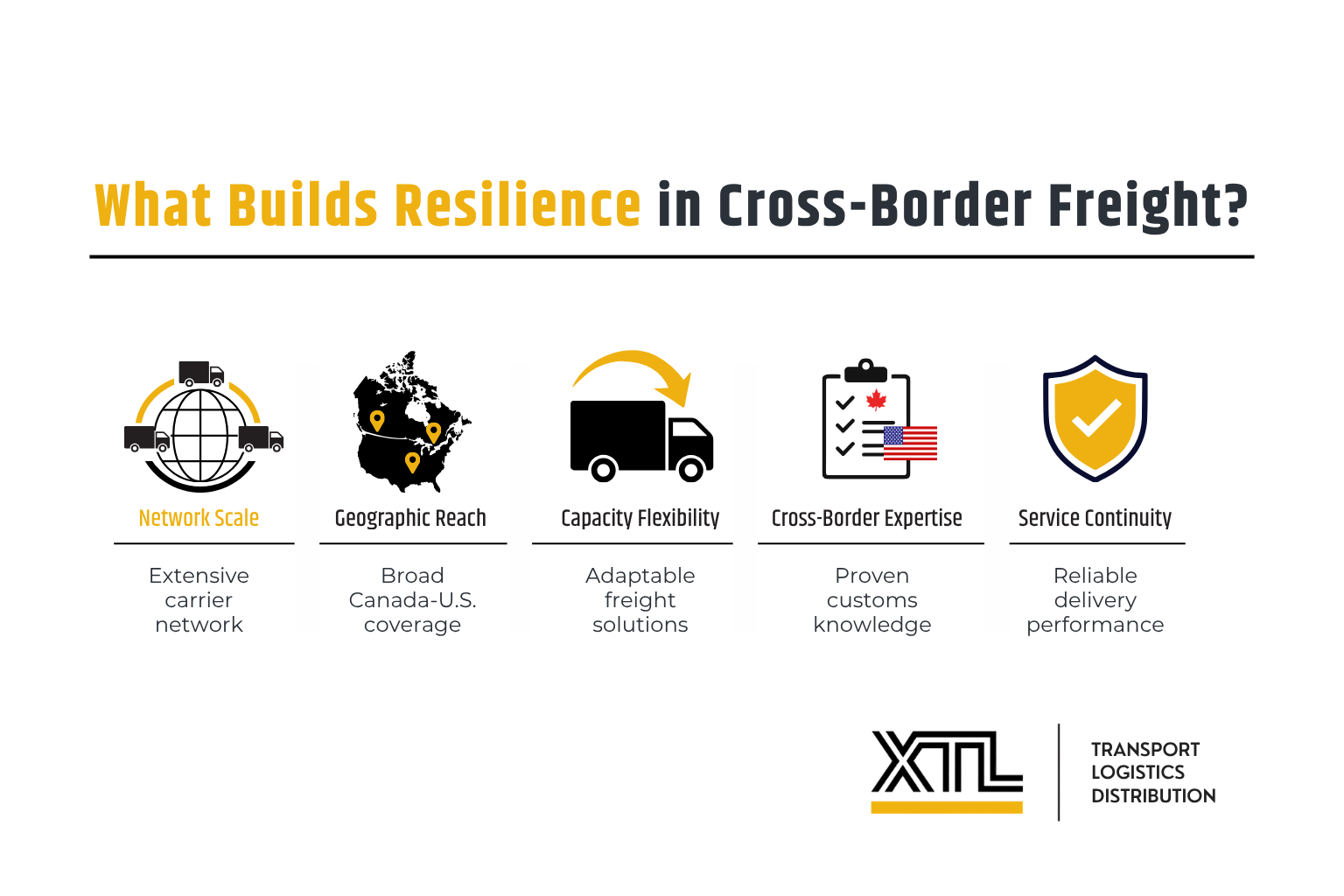
For shippers moving freight between Canada and the U.S., resilience depends less on finding the lowest rate and more on choosing a transportation partner with the scale, reach, and flexibility to keep freight moving when disruptions occur.

That distinction matters because cross-border freight planning is not just a matter of moving goods from origin to destination. It involves border processes, multiple stakeholders, timing dependencies, and a broader range of considerations than many domestic shipments. When one part of that system changes, the impact can extend well beyond a single load.

That is why contingency should not be treated reactively. It should be built into the transportation strategy from the start.

Contingency Is a Strategic Capability

In Canada–U.S. transborder freight, contingency planning is often misunderstood as having a backup carrier or an alternate route available in case something goes wrong. While those tactics can help, they are only part of the picture.

A stronger approach is to view contingency as a structural capability within the freight program itself. In practical terms, that means building transportation plans that can absorb disruption without forcing the shipper to start over every time conditions change.

For operations leaders and supply chain decision-makers, this is less about preparing for unlikely events and more about creating a model that remains stable under normal business pressure. Delays, capacity shifts, border slowdowns, weather events, facility constraints, and changes in customer requirements are not unusual exceptions. They are part of the operating reality of cross-border shipping.

The real question is whether your freight network is designed to adapt.

The Risk of Focusing Too Narrowly on Cost

Cost discipline matters. Every shipper is expected to manage transportation spend carefully. However, cross-border freight planning can become vulnerable when the strategy is driven primarily by lane-by-lane rate minimization.

A lower quoted rate on an individual move may look attractive in the moment, but freight decisions made in isolation can weaken the resilience of the overall transportation model. A partner chosen primarily for a narrow cost advantage may not have the service coverage, network depth, or operational flexibility required when conditions change.

In those moments, the true cost of freight becomes much broader than the rate itself. It can affect customer commitments, inventory flow, production continuity, internal workload, and overall confidence in the supply chain.

This is why mature shippers increasingly evaluate transportation partners not only by the cost of execution, but by their ability to protect continuity and to bring their capacity and network strength to bear when unexpected situations arise.

Why Network Scale Matters in Cross-Border Freight

Cross-border freight does not reward fragility. It rewards flexibility.

That flexibility is easier to achieve when a transportation partner has the scale and geographic reach to support changing conditions across a broader network. A large national partner is often better positioned to respond when a lane tightens, a schedule shifts, a destination changes, or a shipment requires a different solution than originally planned.

This is where network breadth becomes a real strategic advantage. Capacity is important, but capacity alone is not enough. What matters is the ability to draw on a wider service footprint, broader carrier relationships, stronger regional coverage, and operational experience across Canada–U.S. transborder freight flows.

For shippers, that means contingency is not limited to what is written in a plan. It exists in the real-world ability of the transportation partner to reconfigure the move while protecting service.

Resilience Protects More Than Transit Time

When freight professionals talk about contingency, the conversation often starts with delays. In reality, the value of contingency planning is much broader.

A resilient cross-border freight strategy helps protect customer service, stabilize inventory movement, support production schedules, and reduce the constant firefighting that can consume operations teams. It also strengthens communication and decision-making when the unexpected happens, because the underlying transportation model is already built to adapt.

For leadership teams, this has direct business value. Reliability supports credibility. Stability supports growth. A freight strategy that can withstand disruption gives the business more confidence in the commitments it makes to customers, suppliers, and internal stakeholders.

What Shippers Should Look for in a Transportation Partner

If contingency is a structural capability, then it should influence how transportation partners are evaluated.

Shippers should look beyond price alone and ask broader strategic questions. Does this partner have the scale to support our freight as conditions change? Do they have meaningful reach across the lanes and markets we depend on? Can they offer flexibility without forcing us into constant replanning? Do they understand the realities of Canada–U.S. shipping at a network level rather than just at the transaction level?

The right partner does more than move freight efficiently under ideal conditions. The right partner helps create continuity when conditions are less than ideal.

Why This Matters More in Canada–U.S. Shipping

Freight moving between Canada and the U.S. sits at the intersection of operational execution and cross-border complexity. That does not make it unmanageable, but it does mean resilience has to be designed in, not added later.

For many shippers, the most effective form of contingency is not a document sitting on a shelf. It is a transportation strategy built around a partner with the national scale, service geography, and network flexibility to solve problems without disrupting the broader flow of freight.

That is where XTL brings meaningful value. With the breadth of its network and the operational reach to support freight across Canada and transborder shipments into the U.S., XTL helps shippers build cross-border transportation plans that are designed not only for efficiency, but for continuity.

Final Thoughts

In cross-border freight, disruption is not the only variable that matters. The ability to respond without losing momentum matters just as much.

For shippers, operations managers, and supply chain leaders, contingency planning should be viewed as part of the transportation model itself. The goal is not simply to prepare for problems. The goal is to build a freight strategy that remains dependable when the environment changes.

That is what resilience looks like in Canada–U.S. shipping. It is not improvised. It is designed.


Choosing the Right Transportation Partner: Compliance, Safety, and Stability

How to Choose the Right Transportation Provider for Your Supply Chain

Choosing the right transportation provider is one of the most important decisions you can make for your supply chain. The wrong partner can cause delays, compliance issues, and financial exposure. The right partner keeps freight moving safely, efficiently, and without disruption. They reduce risk, protect your brand, and deliver consistent service. Below are the essential factors every business should evaluate when selecting a logistics partner. 

1. Check Safety Records

Safety should always be the first criteria. Review the provider’s safety performance through FMCSA data or provincial authorities. Compare their results to national averages and pay attention to:

  • Accident frequency and severity
  • Hours of service violations
  • Vehicle and driver inspection history

A provider with a strong safety record demonstrates consistent investment in compliance and risk management, reducing the likelihood of claims, delays, and operational issues.

National Average Out of Service Rating as of 10/31/2025:
Vehicle: 22.26%
Driver: 6.67%
Hazmat: 4.44%

Source: https://safer.fmcsa.dot.gov

2. Evaluate Financial Stability

Transportation is a capital intensive industry. A financially stable carrier can maintain equipment, retain talent, and provide reliable capacity. To assess stability, look at:

  • Financial statements if the provider is publicly traded
  • Strong liquidity and profitability
  • References and proof of long term operational health for private carriers

A stable provider is less likely to miss pickups, experience equipment failures, or reduce capacity unexpectedly.

3. Validate On-boarding Protocols for Brokered Freight

If your provider uses partner carriers, review their onboarding procedures. A compliant process should include:

  • Verification of insurance, authority, and licensing
  • Detailed safety audits before onboarding
  • Ongoing monitoring of compliance status

Stronger programs also include fraud prevention, real time alerts for insurance lapses, and monitoring of safety score changes. These steps protect your freight and reduce liability when brokered carriers are involved.

4. Review Worker Benefits and WSIB Coverage

A provider that treats its employees well often delivers better service. Check for:

  • Fair compensation and benefits for drivers
  • WSIB coverage or provincial equivalents
  • Low turnover and an invested workforce

A supported team leads to safer operations and consistent service for customers.

5. How Customers Can Support Their Transportation Providers

A strong partnership goes both ways. As a customer, you play a key role in helping your transportation provider succeed. Here’s how:

  • Pay on Time: Timely payments keep carriers financially stable and able to invest in equipment and staff.
  • Provide Accurate Volume Forecasts: Sharing realistic shipment forecasts allows providers to plan capacity and resources effectively. Volumes fluctuate, but keeping your provider informed prevents unexpected costs.
  • Set Clear Expectations from the Start: Communicate service requirements, delivery windows, and compliance needs upfront to avoid surprises and delays.
  • Ensure Dock Readiness & Appointment Accuracy: Smooth dock processes improve efficiency and significantly reduce detention and dwell time.

Supporting your transportation provider’s success ensures better service continuity and strengthens long-term relationships.


Why These Factors Matter

  • Safety protects your cargo and your brand
  • Financial strength ensures uninterrupted service
  • Strong compliance practices reduce operational risk
  • Worker protections reflect responsible business operations
  • Shipper and carrier collaboration improves efficiency and lowers total supply chain cost

How XTL Meets These Standards

  • Industry-leading safety programs and SmartWay certification
  • Decades of sustained growth and recognized as a Top Fleet Employer of Distinction
  • Rigorous on-boarding and continuous review of brokered/partner carriers
  • Comprehensive benefits and WSIB coverage for employees
  • Over 40 years of stable cross-border and domestic transportation expertise

Ready to Strengthen your Supply Chain?

Contact XTL today for a custom solution that always factors in safety, compliance, and reliability.

Lets build a safer, more resilient supply chain, together.

Why More Businesses Are Rerouting Freight Through Canada

Why Canada is becoming a preferred entry point for goods — and what businesses should know

Global trade patterns are shifting. In recent months, an increasing number of businesses have begun routing goods through Canadian ports — not just as a contingency plan, but as part of a long-term strategy to improve supply chain resilience and reach.

A recent article from The Globe and Mail highlights this growing trend, driven by a combination of operational challenges in the U.S. and competitive advantages in Canada.

What’s Driving the Shift?

Several key factors are influencing this redirection:

  • Congestion at U.S. ports: Ongoing delays at major American ports, particularly on the West Coast, have pushed shippers to look for faster, more predictable alternatives.

  • Canadian port performance: Ports like Prince Rupert and Halifax are becoming attractive due to their capacity, inland connectivity, and strategic location.

  • Cross-border accessibility: Canada offers efficient road and rail links to major U.S. markets, allowing companies to bypass bottlenecks and access distribution networks more directly.

  • Resilience and diversification: Companies are rethinking logistics strategies to include multiple entry points into North America, reducing dependency on any one route.

Implications for Supply Chains

The shift toward Canadian entry points brings both opportunities and operational considerations:

  • Infrastructure strain: As volumes increase, Canadian ports, rail networks, and warehousing capacity will be under greater pressure.

Explore our warehousing solutions in key regions across Canada.

  • Cross-border planning: For U.S.-bound freight entering via Canada, companies need to account for customs coordination and compliance with evolving regulations.

See how we support cross-border freight into the U.S.

  • Retail delivery expectations: Logistics teams must still meet strict delivery windows, particularly when servicing major retailers or time-sensitive markets.

What Companies Should Be Thinking About

As this trend gains momentum, supply chain and logistics professionals may want to evaluate:

  • Whether their current networks are optimized for Canadian routing

  • How flexible their warehousing and transportation capacity is

  • If their partners are experienced in handling cross-border flows and regulatory complexity

  • Opportunities to build resilience by diversifying port and distribution points

This isn’t just a temporary workaround. For many, Canada is becoming a permanent fixture in North American logistics strategy.


 To read more, view the original Globe and Mail article here.

Ready to explore your options? Contact us below:

Consult Request- Reroute to Canada

If you are interested in exploring custom solutions for managing the tariff situation, you have come to the right place.

Name(Required)
Email(Required)
Services Required
Please provide as much information as possible regarding your need. ie. commodity, est # of pallets, preference of warehouse location.

Top 10 Questions About Canadian Transport Companies

Canada’s vast geography presents unique challenges for businesses moving goods across the country and across borders. If you’re wondering how Canadian transport companies operate, here are the answers to 10 of the most common questions, with insights from XTL Transport.


1. Is It Expensive to Ship to Canada?

Shipping costs to Canada depend on several factors, including:

• Shipment origin & destination – Distance and trade imbalances impact pricing.
• Mode of transportation – Air, rail, truck, or sea each have different cost structures.
• Fuel prices & customs fees – Taxes and duties vary by product type.
• Seasonal trends – Peak seasons (e.g., produce season) can increase rates.

Pricing in the transportation industry is more complex than just cost per mile. While many shippers calculate transportation expenses based on mileage, carrier rates are largely driven by market dynamics rather than the actual cost of covering that distance. A key example of this is triangular freight routes, where instead of simple round trips, carriers consider multi-leg routes for efficiency.

For instance, a route like Toronto–Montreal–New York–Toronto allows for better load balancing. In some cases, market rates on one leg of the journey may be lower than the actual cost, but another leg may compensate by being higher than cost. As long as the overall route remains profitable, it makes economic sense for the carrier. This approach highlights the intricacies of freight pricing and how strategic route planning optimizes both costs and efficiency.


2. How Many Trucking Companies Are There in Canada?

There are over 300,000 registered trucking companies in Canada, ranging from small independent operators to large fleets. Trucking moves over 90% of consumer goods and manufactured products. XTL Transport ranks 24th on Today’s Trucking’s list of Canada’s Top 100 for-hire carriers.


3. What Is the Average Salary of a Truck Driver in Canada?

Truck drivers earn between $55,000 and $75,000 per year, depending on experience, location, and haul type. Long-haul and specialized freight drivers often earn more. XTL Transport has been recognized as one of Trucking HR Canada’s Top Fleet Employers, valuing its drivers with competitive pay and benefits.


4. How Long Does It Take to Ship from Vancouver to Toronto?

Transit time between Vancouver and Toronto depends on the shipping method:

  • Truckload (Single Driver): A driver can typically cover 500 miles per day, assuming an average speed of 50 miles per hour over 10 hours of driving. With a distance of approximately 2,700 miles, a single-driver truck shipment would take about 5-6 days, including pickup and delivery.
  • Truckload (Team Drivers): A team of drivers can alternate shifts, allowing for continuous movement and covering up to 1,000 miles per day, reducing transit time to about 3 days.
  • LTL Shipments: Less-than-truckload shipments often involve multiple stops and freight consolidation, which can extend transit time to 6-7 days.
  • Rail Freight: Typically takes 6-10 days, depending on scheduling, terminal handling times, and intermodal connections.
  • Air Freight: The fastest but most expensive option, with transit times of 1-2 days.

Tip: Reduce transit delays and mitigate risks by partnering with a provider that offers both intermodal and truckload services. This allows for greater flexibility in routing and cost optimization.


5. Who Regulates Trucking Companies in Canada?

The trucking industry in Canada is regulated by both federal and provincial authorities. Transport Canada oversees national regulations, while provincial bodies handle regional compliance. XTL Transport adheres to all regulatory standards, ensuring safety and reliability in our operations.


6. How Do Canadian Transport Companies Handle Cross-Border Shipping?

Cross-border shipping requires compliance with Canada Border Services Agency (CBSA) and U.S. Customs and Border Protection (CBP). Many carriers, including XTL Transport, are C-TPAT certified, ensuring faster customs clearance.

Read: Navigating Transborder Trucking


7. What Are the Top Transport Hubs in Canada

Key logistics hubs include:
• Toronto, Ontario – Largest freight hub
• Montreal, Quebec – Key for rail and ocean freight
• Vancouver, British Columbia – Major west coast port
• Calgary, Alberta – Central for Western Canada logistics


8. What Insurance Coverage Do Canadian Transport Companies Offer?

Most carriers provide basic cargo insurance, typically at $4.41 per kg ($2.00 per lb). However, liability limits vary by province and additional coverage may be required for high-value shipments.

Country Standard Carrier Liability
Canada $4.41 per kg ($2.00 per lb)
U.S. $2.00 per lb

For more details, visit:

Transport Canada – Cargo Liability Regulations 

FMCSA Cargo Liability Guidelines


9. How Do Canadian Transport Companies Handle Hazardous Materials?

HAZMAT shipments must comply with Transport Canada and FMCSA (U.S.) regulations. XTL ensures proper classification, labeling, and safety training for hazardous goods.

For more details, visit:

Transport Canada’s Dangerous Goods Regulations

FMCSA Hazardous Materials Regulations


10. What Truck Types and Capacities Are Common in Canada?

• Dry Vans (53ft) – Up to 26 standard pallets
• Refrigerated Trailers – Temperature-controlled freight
• Flatbeds – For oversized cargo

Learn more: How Much Freight Fits on a Truck?


Conclusion

Understanding Canada’s transportation industry is crucial for businesses and individuals alike. XTL Transport’s experience makes us a trusted partner for all your logistics needs. For more information, contact us today.


Winter Logistics: Navigating the Challenges of Temperature-Controlled Transport

As winter approaches, the need for reliable logistics solutions becomes critical for businesses handling temperature-sensitive goods. Fluctuating weather patterns, increasingly harsh winters due to climate change, and rising demand for high-quality heated transport services require shippers to be more vigilant than ever. Whether you’re transporting pharmaceuticals, fresh produce, or other perishable items, ensuring product integrity hinges on choosing the right partner and understanding the nuances of temperature-controlled logistics.

Why Temperature-Controlled Transport Is Crucial

Over the past decade, the demand for temperature-controlled logistics has skyrocketed. This trend is driven by the rise in consumer demand for fresh food, the globalization of pharmaceutical supply chains, and the growing importance of precision in cold chain management.

Winter intensifies the challenges, especially in regions like Canada and the northern U.S., where temperatures can plummet dramatically. The stakes are high: any deviation from the required temperature range can lead to spoilage, financial losses, and even regulatory repercussions for businesses.

The Impact of Climate Change on Winter Logistics

Climate change has reshaped the logistics landscape, with winters becoming more unpredictable and extreme. Canada, for instance, has seen a rise in average winter temperatures by over 3°C since 1950. This warming trend paradoxically results in more intense snowfall and ice storms, increasing the likelihood of transportation delays and risks to temperature-sensitive goods.

For shippers, these conditions amplify the need for advanced solutions that can maintain product integrity despite external disruptions.

Know the Difference: Temperature-Controlled vs. Protect from Freeze

A key consideration for businesses is understanding the distinction between temperature-controlled transport and protect from freeze services. While both aim to shield goods from adverse conditions, they differ in scope and capabilities.

Protect from Freeze

  • Definition: This service prevents products from freezing during transit, ensuring temperatures remain above the freezing point.
  • Methodology: Approaches vary and may include:
    • Transit Timing: Scheduling shipments to minimize exposure to freezing conditions.
    • Insulation: Using materials to reduce heat loss.
    • Portable Heaters: Employing diesel-fired heaters to add warmth without precise temperature control.
    • Heated Warehousing: Storing goods in heated facilities between transit legs.
  • Limitations: These methods don’t guarantee a specific temperature and may not suffice for products requiring strict thermal conditions.

Temperature-Controlled Transport

  • Definition: This service maintains products within a specified temperature range throughout transit, regardless of external conditions.
  • Methodology: Utilizes advanced equipment such as:
    • Refrigerated Trailers: Equipped with precise heating and cooling systems.
    • Real-Time Monitoring: Continuous tracking of internal temperatures.
    • Insulation: High-quality materials to minimize temperature fluctuations.
  • Advantages: Ensures consistent temperatures, making it ideal for sensitive goods like pharmaceuticals and certain chemicals.

Key Differences

  • Precision: Temperature-controlled transport offers exact temperature maintenance, whereas protect from freeze aims only to prevent freezing without precise control.
  • Reliability: Temperature-controlled services provide consistent conditions, while protect from freeze methods can be less dependable, especially in extreme cold.
  • Applicability: Products with strict temperature requirements necessitate temperature-controlled transport, whereas less sensitive items might suffice with protect from freeze services.

Choosing the right solution depends on the nature of your cargo. For high-stakes shipments, temperature-controlled transport offers peace of mind and ensures compliance with regulatory standards.

XTL: A Leader in Temperature-Controlled Transport

XTL is a trusted name in temperature-controlled logistics, offering tailored solutions to meet the diverse needs of shippers:

  1. State-of-the-Art Equipment:
    XTL’s fleet is equipped with advanced technology to ensure precise temperature control. Features include real-time monitoring, diagnostics, and live updates to ensure every shipment is protected throughout its journey.
  2. Comprehensive Services:
    XTL offers truckload, and dedicated transportation options across Canada and the U.S., catering to a wide range of shipping requirements.
  3. Proactive Monitoring:
    With live diagnostics and alerts, XTL can quickly identify and address potential issues, ensuring products remain safe regardless of external disruptions.
  4. Regulatory Compliance:
    From hazardous materials to pharmaceutical products, XTL adheres to stringent quality control standards, making them the preferred partner for sensitive shipments.

How Shippers Can Prepare for Winter

To ensure successful shipments during the harsh winter months, shippers should adopt the following best practices:

  • Monitor Weather Conditions: Stay updated on forecasts and plan shipments around potential disruptions.
  • Collaborate with Carriers: Work closely with transportation providers like XTL to develop contingency plans.
  • Optimize Packaging: Use insulated packaging to provide an additional layer of protection.
  • Schedule Strategically: Avoid peak times and plan for extra lead time in case of delays.
  • Leverage Technology: Use tracking systems to maintain visibility over shipments and ensure compliance with temperature requirements.

Staying Ahead in a Challenging Climate

The logistics industry is evolving, with heightened demands and harsher winters reshaping how goods are transported. Understanding the complexities of temperature-controlled transport and partnering with industry leaders like XTL, businesses can safeguard their products and maintain customer trust.

Winter may bring challenges, but with the right strategies and partners, your supply chain can remain resilient and reliable. When it comes to temperature-sensitive goods, don’t settle for anything less than the precision and reliability of true temperature-controlled transport. Let XTL be your partner in navigating the complexities of winter logistics.

Integrated Supply Chain Solutions: How the XTL Group Elevates Food and Beverage Logistics

In the fast-paced world of food and beverage logistics, efficiency, reliability, and safety are non-negotiable. At the XTL Group, which encompasses our Transport, Logistics and Distribution divisions, as well as CBT Inc and Savoie Express Inc—we form a powerhouse alliance that delivers comprehensive solutions for food shippers. Together, we offer custom end-to-end supply chain services, seamlessly blending our strengths to meet the industry’s diverse needs.

A Legacy of Excellence

Founded in 1985, XTL has been a trailblazer in crafting custom supply chain solutions. Boasting over 450 trucks, 1250 trailers, and 2.5 million square feet of warehouse space, our capabilities are expansive. Our services span dry and temperature-controlled over-the-road and intermodal transportation, logistics, and ambient warehousing. With state-of-the-art equipment and deep-rooted experience, we ensure smooth supply chain operations, maintaining the quality of fresh, frozen, and dry food products. 

CBT Inc has been a significant logistics provider for the food service giants as well as the top poultry and egg producers in southeastern U.S. since 1989. Operating out of Oakwood, GA, CBT complements the XTL offering by prioritizing exceptional customer service to the domestic U.S. market. CBT’s experience comes from years of familiarizing themselves with the various industry shipping and receiving requirements, time-sensitive shelf dates, weight limitations, and proper handling techniques. Their extensive carrier network ensures reliable capacity and on-time deliveries, establishing them as a trusted partner for food shippers.

Since 1964, Savoie Express has been committed to delivering excellence with every mile. With a fleet of over 40 trucks out of Manseau, QC, Savoie Express provides top-tier service that compliments XTL service regions while also extending the XTL reach further into eastern Canada. Becoming a part of the XTL Group fueled significant growth, doubling their fleet and enhancing service capabilities. Specializing in hauling perishable products across North America, Savoie Express’s dedication to partnership through service has been a cornerstone of their long-term success.

Solving Industry Challenges

At XTL, solving business problems for food shippers begins with understanding root issues and collaborating with all parties involved. We blend expertise, state-of-the-art equipment, and clear communication channels to quickly resolve problems. Our established network provides consistent capacity, crucial for maintaining the quality and timely delivery of food products.

CBT’s focus on building strong relationships and leveraging technology, ensures reliable capacity and on-time deliveries. CBT’s proactive approach to staying updated with industry trends and technology paired with extensive experience, has enabled them to stay competitive and agile while also bringing stability to fluctuating market conditions. This level of support has been instrumental in their customers’ success within their transportation departments.

Savoie Express remains steadfast in its growth objectives since becoming a part of the XTL Group. Doubling their fleet and recruiting dedicated drivers has enabled them to meet customer demands effectively, ensuring reliable service. Their unwavering commitment to never letting a customer down is vital in the perishable goods sector. Savoie Express always has a contingency plan to offer solutions for unexpected challenges ensuring deliveries are completed on time, every time.

Recent Achievements and Success Stories

In the past year, XTL has achieved AIB International accreditation in four of our nine distribution centers, with plans to expand this accreditation further. This milestone reflects our commitment to maintaining the highest standards of food safety and good manufacturing practices. By investing in new infrastructure and securing necessary accreditations, we provide our partners with room to grow, offering stable and long-term solutions.

CBT has made significant strides by joining the TIA Fraud Task Force to combat industry fraud and enhancing the carrier vetting process. These continuous efforts to create a positive work environment based on trust and respect have contributed to CBT’s growth and success.

Savoie Express’s proud legacy since 1964, combined with their recent growth, showcases their commitment to excellence. Their long-standing relationships and dedicated service have been crucial to their success. A prime example of their impact is their ability to adapt and maintain high service standards amidst industry challenges, solidifying their reputation as a dependable partner in the logistics of perishable goods.


Conclusion

The synergy between XTL, CBT, and Savoie Express exemplifies the power of collaboration in the logistics industry. By combining our unique strengths and an unwavering commitment to excellence, we provide comprehensive and reliable solutions for food and beverage shippers. This integrated approach ensures that supply chains remain efficient, safe, and adaptable, meeting the ever-changing demands of the industry.

Keurig Dr Pepper Canada selects Calgary region for its new distribution centre in Western Canada

Keurig Dr Pepper Canada takes over 100,000 sq. ft. of XTL Group’s new distribution centre to support growth and enhance customer service in Western Canada

Balzac, Alberta, July 22, 2024 – Keurig Canada Inc., doing business as Keurig Dr Pepper Canada (KDP Canada), announced today an expansion of its distribution capabilities through an agreement with XTL Group (XTL) for the lease of a 100,000 square foot space in their new warehouse in Balzac, just outside of Calgary. This strategic expansion is designed to significantly enhance the Company’s ability to service its growing customer base in Western Canada and, in part, supports the creation of 50 new jobs for Albertans. By strengthening its supply chain network and improving operational productivity, KDP Canada aims to support the increasing demand for its diverse product range and its ongoing growth.

Covering an impressive 474,000 square feet, this state-of-the-art facility, managed and operated by XTL Group, includes 40-foot clearance, 16,000 racking positions, over 400,000 sq. ft of bulk storage, 112 loading dock doors, 120 trailer parking spots and is C-TPAT certified, making it the ideal choice for preserving bottled beverages, coffee products, and small appliances.

Keurig Dr Pepper Canada’s operations from the new XTL distribution centre will begin in July 2024. Other terms of the agreement have not been disclosed.

Quotes

“In addition to expanding our already significant distribution footprint in Canada, the decision to establish our operations in this new distribution centre in the Calgary region marks a major milestone in our growth and innovation journey. This multi-million-dollar investment over the next five years underscores our unwavering commitment to providing exceptional service to our customers in Western Canada. This new collaboration with the XTL team will also enable us to improve the flexibility and responsiveness of our operations from the Port of Vancouver.”

Carl Saba, Vice-President of Supply Chain & Operations, Keurig Dr Pepper Canada

“XTL Group has made a significant investment in Alberta’s economic sector with the creation of over 200 jobs since we first began operating here in 2008. The construction of this infrastructure will lead to an additional 50 jobs in handling, logistics management, and delivery services to serve tenant businesses. Our team is proud to provide world-class infrastructure to support the operations and initiatives of companies like Keurig Dr Pepper Canada that wish to establish a foothold in the Calgary region.”

Luc Francoeur, VP Sales, XTL Group

“We’re thrilled that Keurig Dr Pepper has chosen to invest in Alberta, making us a part of their Western Canada expansion. This is one more proof point that Alberta is the best place to do business. Our ongoing work to build Alberta’s economy means more jobs for Albertans in more industries.”

Danielle Smith, Premier of Alberta

“Alberta’s government is proud to welcome Keurig Dr Pepper Canada to Alberta. Their decision to expand their distribution capabilities in Rocky View County represents a significant vote of confidence in Alberta’s economic resilience and strategic advantages. This multi-million-dollar investment underscores our commitment to fostering job creation and economic growth in Western Canada.”

Matt Jones, Alberta Minister of Jobs, Economy and Trade

“We are honoured that Balzac was chosen for Keurig Dr Pepper’s first western Canadian location. The decision to join our growing and varied list of companies underscores the County’s commitment to fostering a supportive and thriving business environment and we look forward to seeing the positive impact and opportunities this expansion brings to our region’s economy.”

Reeve Crystal Kissel, Rocky View County

“Keurig Dr Pepper and XTL Group’s investment is a significant win for Alberta, creating more than 50 permanent new jobs and positioning Balzac as a distribution hub. Collaboration between Invest Alberta, Keurig Dr Pepper Canada, and Rocky View County supported their final decision with this strategic expansion of their operations. We are honoured to help the company better service their Western Canadian base while enhancing the Alberta economy with this high-profile group of brands.”

Rick Christiaanse, CEO, Invest Alberta

About Keurig Dr Pepper Canada

Keurig Dr Pepper Canada is a leading beverage company, with a portfolio of more than 70 owned, licensed, and partner brands and powerful distribution capabilities to provide a beverage for every need, anytime, anywhere. We hold leadership positions in categories including coffee, tea, soft drinks, juice and mixers, and have the #1 single-serve coffee brewing system in the country. Our innovative partnership model builds emerging growth platforms in categories such as premium coffee, energy, sports hydration and non-alcoholic beer. Our iconic brands include Canada Dry®, Van Houtte®, Keurig®, Crush®, Dr Pepper®, Mott’s® Clamato®, Mott’s® Fruitsations®, Timothy’s®, Atypique®, and Snapple®. Driven by a purpose to Drink Well. Do Good., our 1,500 employees aim to enhance the experience of every beverage occasion and to make a positive impact for people, communities, and the planet. For more information, visit keurigdrpepper.ca and follow us on LinkedIn. To learn more about our commitment to corporate social responsibility, visit keurigdrpepper.ca/corporate-responsibility.

About Invest Alberta

Invest Alberta attracts high-impact, high-value investments into Alberta, Canada by providing best-in-class concierge services for investors and companies. With investment advisors strategically positioned in key markets around the world, Invest Alberta works to remove barriers for businesses to start, scale, and succeed. Since 2020, Invest Alberta has supported the commitment of approximately $20 billion in investment and more than 26,000 new jobs for Albertans. For more information, visit investalberta.ca.

About XTL Group

Established in 1985, the XTL Group provides customers across North America progressive and customized end-to-end supply chain solutions that combine the key strengths of our 3 distinct service offerings: asset-based transport, logistics, and distribution. With a fleet of 500 trucks, 1300 dry, temperature controlled and specialized trailers with multi-axle configurations, 2.5 million square feet of warehousing space and an extensive network of partner carriers, our fully integrated supply chain solutions support the business needs of our partners and adds value to their core competencies. Our partners will benefit from our company-wide commitment to understanding and responding to their business needs in a safety-first and regulatory-compliant environment that delivers on-time results. XTL is C-TPAT, CSA, FAST, PIP & SmartWay certified, AIB Accredited, and has been named Trucking HR Canada’s Top Medium Fleet for the last two years. Visit www.xtl.com for more information.