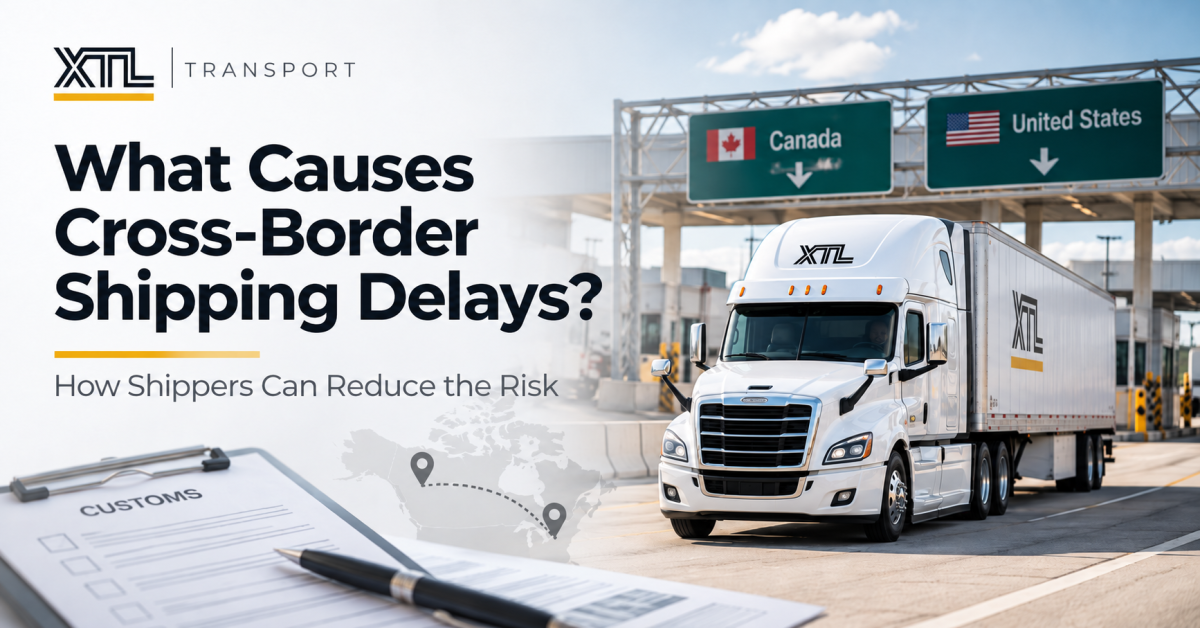
A driver arrived at the U.S. border with a load of frozen meals we regularly transport, expecting a routine crossing. Instead, a new import requirement left the shipment waiting and the driver sleeping at the border.
A truck can leave the shipper on time, encounter no traffic, and still lose hours at the border because the customs broker does not have the right paperwork, information does not match between systems, an inspection has not been coordinated, or a required permit is missing.
Some border delays cannot be avoided. Customs examinations, weather, congestion, and other unexpected events will always be part of cross-border transportation. However, many delays begin long before the truck reaches the border.
Understanding the most common causes and addressing them before a shipment leaves the dock is key to significantly reducing the risk of unnecessary delays.
Incorrect or Incomplete Customs Documentation
Documentation problems are among the most preventable causes of cross-border shipping delays.
A commercial shipment may require information such as the product description, quantity, value, country of origin, and other details needed by the importer and customs broker to prepare the appropriate customs entry.
Problems can arise when documentation contains:
- Incorrect or incomplete product descriptions
- Incorrect quantities, weights, or values
- Country-of-origin errors
- Missing information
- Incorrect tariff classifications
- Discrepancies between the commercial invoice, bill of lading, and other documents
- Information that does not accurately describe the freight actually on the truck
Product descriptions are particularly important. A description such as “parts,” for example, may not provide enough information to accurately identify the goods being imported.
The carrier can help ensure that documentation received for the shipment is forwarded to the appropriate customs broker, but the carrier is not a customs broker. The shipper, importer, and customs broker remain responsible for ensuring that customs documentation and entry information are accurate and appropriate for the shipment.
The earlier documentation is prepared and sent to the broker, the more opportunity there is to identify and resolve an issue before the truck reaches the border.
PARS, PAPS and Electronic Customs Information Must Match
Modern Canada-U.S. customs processing is highly electronic, but shipment identification and matching remain critical.
For freight entering Canada, the Pre-Arrival Review System (PARS) allows importers and customs brokers to submit release information to the Canada Border Services Agency before the goods arrive. CBSA continues to use PARS as part of the commercial release process.
For U.S.-bound freight, carriers, brokers, and importers similarly rely on electronic pre-arrival customs processes through U.S. Customs and Border Protection systems.
Problems can occur when:
- An incorrect PARS or PAPS number is provided
- A shipment number is duplicated
- The customs broker has a different number than the carrier
- Information in the carrier’s electronic submission does not match the broker’s entry
- Shipment details change after customs information has already been submitted
- Documents are provided too late for processing before the truck arrives
Something as small as an incorrect reference number can prevent customs systems from properly matching the carrier’s shipment information with the broker’s customs entry.
This is why cross-border planning should happen before the truck is sitting in a border lineup.
Customs Broker Problems Can Leave a Truck Waiting
Providing the name of a customs broker does not necessarily mean that the broker is ready to clear the shipment.
A shipment can be delayed because:
- The wrong customs broker was identified
- The broker never received the paperwork
- Documentation was sent too late
- The broker was not notified that the shipment was coming
- The importer has not completed the necessary account setup
- There is a payment or credit issue between the importer and broker
- Nobody from the broker is available when a problem occurs
Broker availability can be particularly important for shipments moving at night, on weekends, or during holidays.
A border crossing may operate around the clock, but that does not mean every customs broker or other party needed to resolve a problem provides 24-hour service.
Canada’s commercial-import accounting environment has also changed significantly with the introduction of the CBSA Assessment and Revenue Management system (CARM). CARM is now CBSA’s official system for accounting for commercial imports and paying applicable duties and taxes.
For shippers, the practical lesson is simple: confirm the correct customs broker early and make sure the appropriate documentation reaches them before the shipment approaches the border.
Food and Meat Shipments Require Additional Planning
Cross-border food transportation can introduce another layer of complexity because customs clearance may be only one part of the import process.
Depending on the product, additional government agencies can become involved.
In Canada, the Canadian Food Inspection Agency (CFIA) regulates the importation of many food, animal, and agricultural products. In the United States, meat, poultry, and certain egg products are regulated by the U.S. Department of Agriculture’s Food Safety and Inspection Service (USDA FSIS), while other types of food may fall under different agencies.
Meat is a good example of why advance planning matters.
For meat entering Canada, importers or their representatives may need to provide certificates and other documentation to CFIA’s National Import Service Centre. Certain shipments may also be selected for inspection and directed to an establishment licensed to handle imported meat for inspection.
For meat, poultry, and egg products entering the United States, USDA FSIS also has specific import certification and re-inspection requirements, including presentation at an official import inspection establishment where required.
These processes have to be considered before the truck simply proceeds toward the border.
Inspection capacity can also become a source of delay. During periods of heavy volume, a driver may have to wait for an inspection to be completed.
For refrigerated and frozen products, an inspection introduces another operational consideration: protecting the cold chain. Inspectors may require access to the trailer or product while the carrier is simultaneously trying to minimize door-open time and maintain the required temperature.
A delay associated with a required government inspection is not necessarily preventable. Proper planning, however, can help avoid arriving without the required documents, approvals, or arrangements already in place.
We experienced the operational impact of a regulatory change firsthand with a load of frozen meals for a key customer. The U.S. Department of Agriculture’s Animal and Plant Health Inspection Service (USDA APHIS) made a change requiring an import permit and manufacturer’s statement for food products containing egg ingredients entering the United States. Applying for the permit required a complete list of ingredients of animal origin to be provided to the U.S. importer or customs broker. Without the required information in place before the shipment reached the border, the load could not proceed, and the driver had to sleep at the border while the issue was resolved.
Alcohol, Tobacco, Firearms and Other Highly Regulated Goods
Some commodities involve regulatory requirements beyond those associated with an ordinary commercial shipment.
Examples may include:
- Alcohol
- Tobacco
- Firearms and certain firearms-related products
- Some chemicals
- Pharmaceuticals
- Other controlled or restricted goods
Depending on the commodity and direction of travel, the importer may require specific licences, permits, declarations, tax or excise documentation, or authorization from another government agency.
The exact rules vary considerably by product, importer, origin, and destination, so these requirements should be determined by the appropriate regulatory and customs professionals before the shipment is tendered to the carrier.
For the transportation provider, the important issue is knowing that additional requirements exist and ensuring that the transportation plan reflects any special instructions that have been provided.
Discovering at the border that a permit, authorization, or regulatory step is missing can result in a substantial delay.
Timing Can Turn a Small Problem Into a Long Delay
Timing matters in cross-border transportation.
Consider a relatively simple paperwork question. During normal business hours, the carrier may be able to contact the shipper or customs broker and resolve it quickly.
The same problem at 2:00 a.m. can be very different.
Potential timing issues include:
- Customs brokers that do not provide 24-hour support
- Government inspection facilities with defined operating hours
- Weekend or holiday schedules
- Paperwork sent shortly before the truck reaches the border
- Last-minute changes to the shipment
- Difficulty reaching the shipper or importer after regular business hours
This does not mean shippers should avoid after-hours crossings. It means the availability of all parties involved should be considered when planning a time-sensitive shipment.
A problem that takes ten minutes to resolve when the right person is available can become a multi-hour delay when nobody knows who to contact.
Some Border Delays Cannot Be Prevented
Even a perfectly prepared shipment can sometimes be delayed.
Customs authorities may refer a shipment for further examination. Traffic can back up at a busy crossing. Severe weather can affect border operations. Government or carrier systems can experience outages.
Other potential causes include:
- Random or targeted customs examinations
- Increased enforcement activity
- Border congestion
- Accidents or road closures
- Severe weather
- Government system interruptions
- Unexpected operational restrictions
It is important to distinguish these events from avoidable delays.
A shipment delayed because customs selected it for examination is very different from one delayed because nobody sent the commercial invoice to the broker.
Shippers cannot eliminate every source of uncertainty from cross-border transportation. The goal should be to remove as many preventable causes as possible so the shipment is better positioned to deal with the things that cannot be controlled.
Communication Is Often the Difference Between a Short Delay and a Long One
Cross-border transportation involves several parties, each with a different role.
Depending on the shipment, those parties can include:
- The shipper
- The importer of record
- The customs broker
- The carrier and load coordinator
- The driver
- The consignee
- Government inspection or regulatory agencies
Problems occur when one party assumes somebody else has taken care of something.
Perhaps the shipper believes the broker has the documents, while the broker has never received them. A shipment detail changes but the carrier is not advised. An issue arises at night and nobody has an after-hours contact for the importer.
An experienced carrier will generally make reasonable efforts to ensure that the shipping documents it receives are directed to the designated customs broker and that known transportation requirements are coordinated before the driver proceeds to the border.
That does not mean the carrier performs the customs broker’s job or independently verifies customs compliance.
Instead, good cross-border transportation depends on keeping the various parties connected and making sure important information gets to the right people at the right time.
How Can Shippers Reduce the Risk of Cross-Border Delays?
While there is no way to guarantee that a cross-border shipment will never encounter a delay, shippers can reduce many of the most common risks.
Before Pickup
Confirm:
- Who is the importer of record?
- Which customs broker will handle the shipment?
- Does the broker have the required shipment information?
- Will the broker be available around the expected crossing time?
- Are any special permits, certificates, or regulatory requirements involved?
- Does the commodity require a government inspection?
- Has accurate commercial documentation been prepared?
For regulated products, these questions may need to be answered well before the day of pickup.
Before the Truck Reaches the Border
Make sure:
- Required documents have been sent to the appropriate parties
- PARS, PAPS, or other shipment identification information is correct
- The broker and carrier are working from consistent shipment information
- Any changes to quantities, products, or shipment details have been communicated
- Required inspections or other regulatory steps have been addressed
- Appropriate contacts are available if an issue arises
CBSA, for example, specifically instructs carriers using PARS that the invoice or bill of lading should be sent to the broker in advance of the goods arriving in Canada.
For Time-Sensitive, Refrigerated, or Regulated Freight
Allow additional planning for:
- Broker operating hours
- Government inspection requirements
- Inspection-facility schedules
- Temperature-control requirements
- Holidays and weekends
- Contingency time when an inspection or referral is possible
The more complex the shipment, the more important it is to identify potential problems before the truck begins moving.
Experience Helps Reduce Avoidable Cross-Border Problems
A transportation provider cannot guarantee customs clearance, and a carrier does not replace the expertise of a licensed customs broker.
What an experienced cross-border carrier can do is understand the transportation process surrounding the border.
That includes making reasonable efforts to ensure required shipping documents received by the carrier are forwarded appropriately, coordinating information with the parties involved, understanding the additional planning required for specialized freight, and avoiding sending a driver into an obvious problem when possible.
This becomes particularly important with time-sensitive, temperature-controlled, and highly regulated shipments where a delay can have consequences beyond simply arriving late.
At XTL, cross-border transportation is part of our everyday business. Our role is to move freight safely and efficiently while working with our customers, their designated customs brokers, and other involved parties to help keep shipments moving.
The Best Time to Prevent a Border Delay Is Before the Truck Leaves
Not every cross-border delay can be avoided.
Customs inspections will occur. Weather happens. Border traffic can be unpredictable. Government agencies have their own requirements and operating constraints.
But many frustrating delays can be traced back to something that happened, or failed to happen, before the truck ever arrived at the border.
Accurate documentation, early broker coordination, proper planning for regulated commodities, and good communication between everyone involved can substantially reduce that risk.
When it comes to cross-border transportation, the best time to solve a border problem is often before the truck leaves the shipper’s dock.
Call XTL today to help plan your next cross-border shipment.